As women from Tunceli—one of the smallest cities in Turkey—who have been negatively affected by internal conflicts and often marginalized due to our Kurdish and Alevi identities, traveling to the Basque Country in Spain was an incredibly powerful and transformative experience for us.
For the 9 women working within the Zembul Women’s Cooperative, this journey was not just a trip, but a turning point that reshaped our perspective.
Before coming here, we believed that life and struggle were limited to our own surroundings. Our understanding was confined to our own reality. However, as we got to know the Basque people, we realized how many similarities we share. Seeing that similar struggles and emotions exist in different geographies and languages deeply moved us.
We were aware that the work we do in our cooperative is valuable. However, we often struggled to express and communicate this value. Through the meetings and interactions within this project, we came to an important realization: We are not producing only for ourselves. Production carries meaning not only for sustaining our own lives, but also for people we do not know—for other women, for other lives.
We began to transform from a community that had withdrawn into itself and perceived production merely as a means of survival, into one that understands production as a value to be shared.
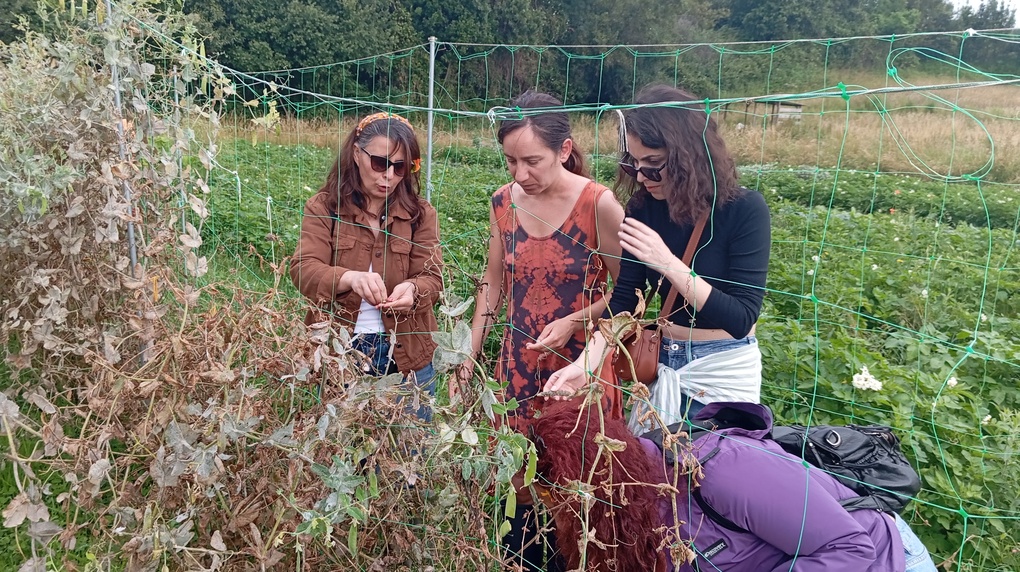
One of our most important realizations during this process was this: To make our environment and the world a better place, we must act together. We must benefit from each other’s love, knowledge, and strength.
Our journey from Tunceli to the Basque Country showed us how culturally similar our two societies are. We saw that the shared values of being human go far beyond borders.
For a long time, being part of the European Union was very important to us. We believed that issues related to human rights, democracy, and living standards could only be resolved this way. However, after these encounters, we understood something deeper: The issue is not simply whether we are part of the Union or not.
Every society has its own strengths and weaknesses. While people in Europe have certain advantages, we also have many strengths compared to them.
For example, we observed that things which are difficult to access for us are quite easy to obtain here. At the same time, we realized that our living conditions are more challenging in areas such as education, healthcare, human rights, democracy, and security.
Yet, we also became aware of something very valuable: After experiencing the food here, we understood much better the quality, naturalness, and richness of the food produced in an endemic geography like Tunceli.
Although the widespread use of technology and the high consumption of packaged food in these regions may seem appealing at first glance, it is clearly risky for the future.
After all these experiences, we asked ourselves: “What should we do?”
Our answer was clear: Yes, we produce—and this is very valuable. But we must strengthen our production, improve it, and make better use of it.
We should engage with more cultures and overcome the barriers between countries. A world where societies can build on each other’s strengths is possible.
One of our most important conclusions was this: Younger generations must be included in cultural work and production processes. Women’s active participation in all areas of life must be increased.
Because now we know that change is only possible together.